


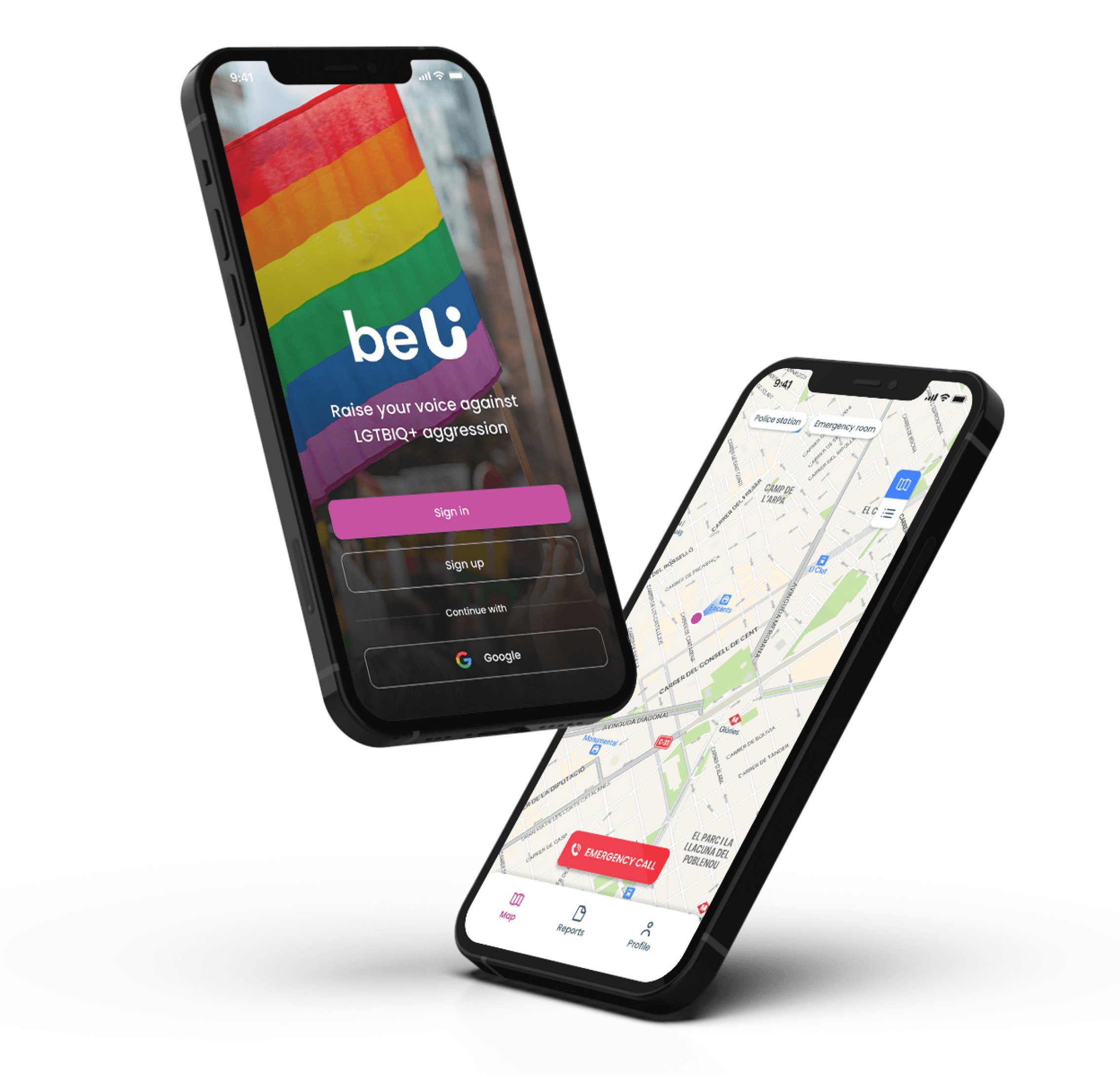
I partnered with the OCH (Observatori Contra l’’Homofobia) from Barcelona to get more data and create something meaningful. OCH is a center where you will find activists, professionals, and volunteers specializing in different fields. The center is an instrument at the service of the LGBTIQ+ community and citizenship.
The purpose of this project was to offer our users a symbolic helping hand after LGTBI-phobic aggression.
During my final master's project, I wanted to work on a project that made a meaningful and significant contribution to the LGTBIQ+ community.
People from the LGTBIQ+ community in Barcelona are being verbal and physically assaulted. They feel alone and scared and don’t know what to do after the assault.
Nowadays, in Barcelona, the only existing center for the LGTBIQ+ community recognized by the city council is the LGTBI center from Barcelona. On the LGTBI center, you can find the OCH, who I partnered with to get data and their insights after many years of helping the community in the city.
The OCH has a system form where users can send a report to them with a small description of what happened.
· Create a journey to assist people who have been aasaulted during these difficult times and empathize with them.
· Encourage people to report to the police all kinds of aggressions and get medical attention if needed.
Homophobic aggressions have increased 40% in Barcelona compared to 2018 according to data obtained by "l’Observatori Contra l’Homofobia" (OCH).
I decided to start my research because the statement mentioned before and I focused the investigation on how people act when they suffer from LGBTI-phobic aggression.
I did 2 sessions with the OCH team to speak about the protocole when someone contacted them because they have been assaulted. Also as mentioned before they explained to me that they provide to the assaulted person with pshycosocial support and legal advice.
Some insights I got from those sessions were:
· People don’t trust the police, specially people from the transgender community. They don’t feel respected or protected.
· Is really difficult to encourage people to report the aggressions to the police.
· After those situations they are so vulnerable, they need to feel protected, listened and loved.
· People believes that reporting to the OCH is a legal solution and is not.
After those sessions with the OCH, I prepared a survey and an interview script to get in touch with people that felt encouraged to speak about that traumatic experience.
The main objectives were to understand:
How do people feel/act after the aggression happens?
Why do people not report to the police?
Why do people not trust the police?
What do people think they would do if experience an aggression?
I conducted 12 interviews. I need to mention that it was hard to do them. They were opening up to me about a traumatic moment. It was difficult to hear about their traumatic experience. I tried to comfort them, let them speak, and hear all they needed to say about the aggression and how they felt in that moment and after. I also shared an online survey that thanks to the OCH and other LGTBI accounts on Twitter got 173 answers.
Quick summary:
· 12 Interviews to people that has experienced an aggression.
· 173 online surveys answered.
After finishing the interviews with all 12 participants, I built an affinity map on Miro with all the notes, conclusions and thoughts of the interviews and 173 surveys to come up with the main insights:
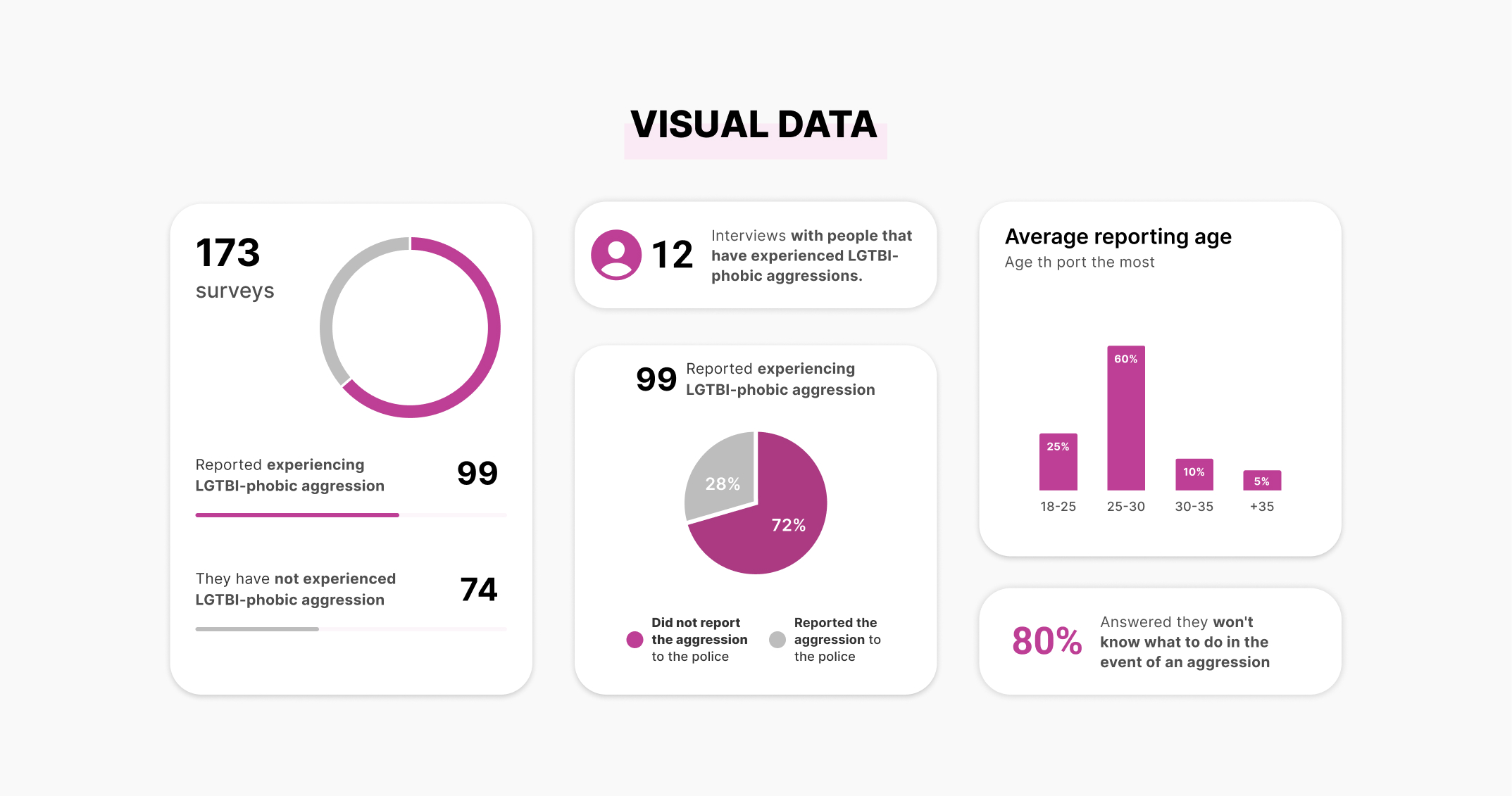
· Out of 173 respondents, 99 reported experiencing LGTBI-phobic aggression.
· There were 72 people out of 99 who did not report the aggression to the police.
· Approximately 70% of respondents said they didn't know where to go if they experienced an assault or where to find the police station.
· According to 80% of respondents, they won't know what to do in the event of an aggression.
· People do not report verbal aggression because they feel it is pointless.
· People do not report aggressions to the police because they don’t trust the police.
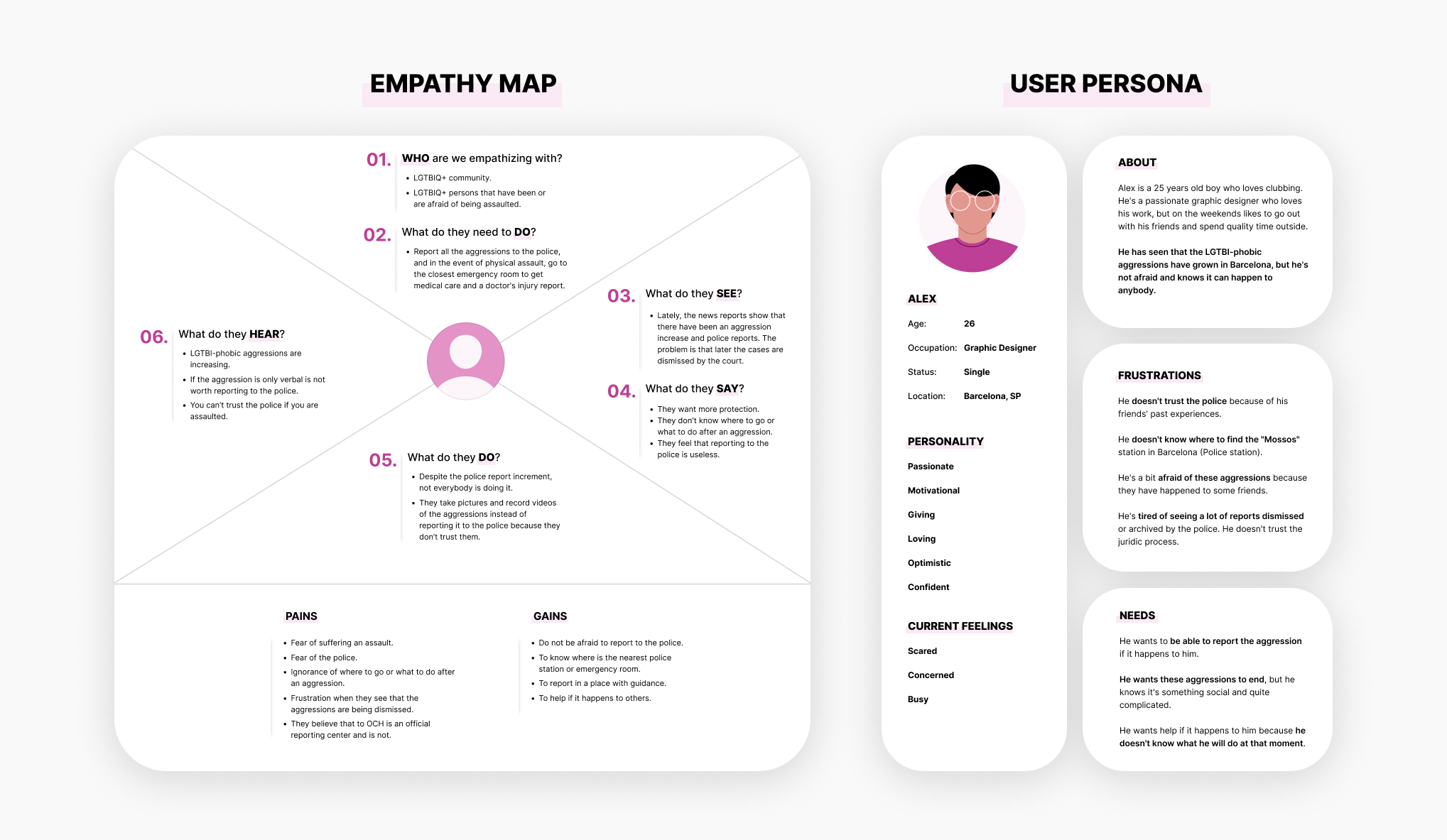
Following the process, those insights had to become into what my user thinks. I did it through an empathy map to help me create a user persona.
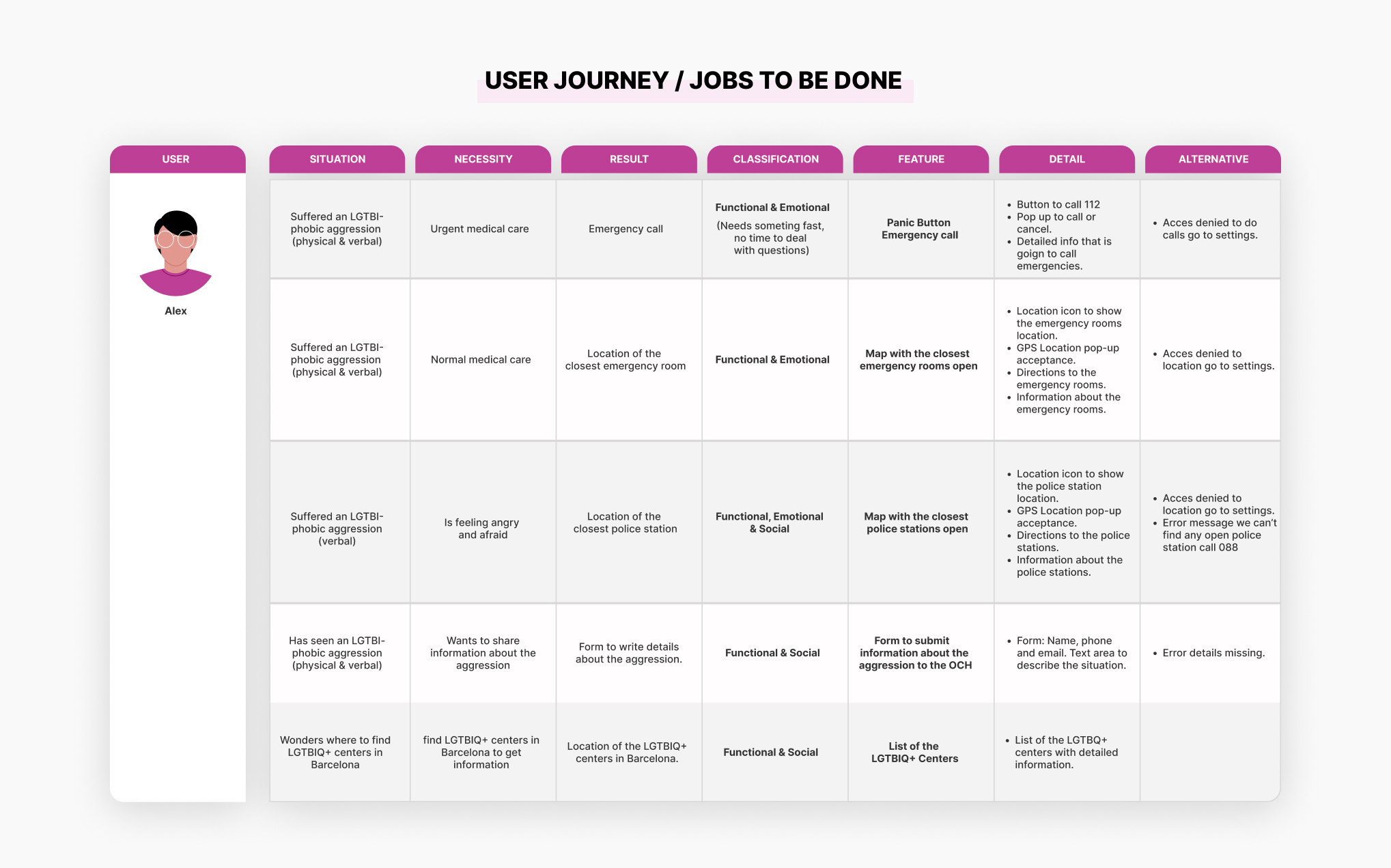
Once I defined the user persona and their main needs. I have put together a hybrid of a User Journey & Jobs to be done. I focalized in the moment I will help my user and also how they could be help:
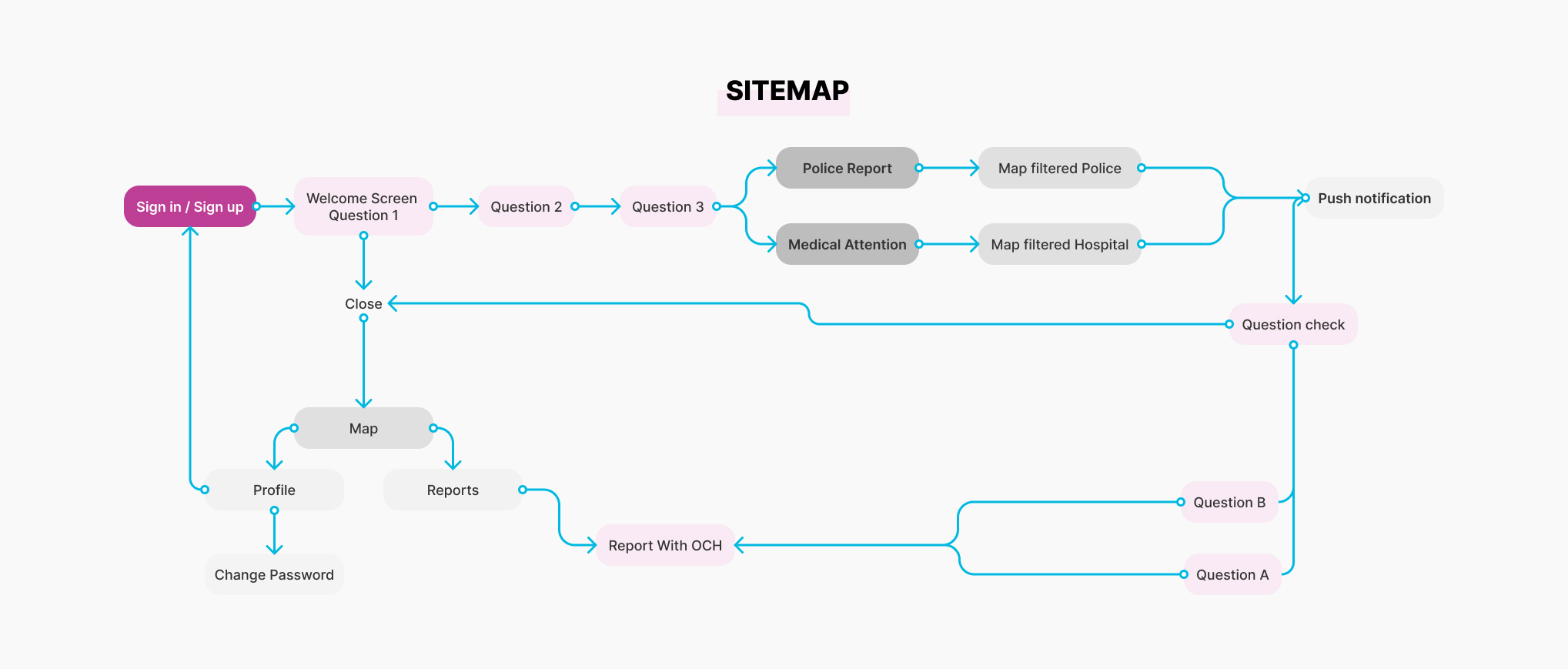
I created a sitemap that produced some questions. With consideration, I could work though them as I wanted to avoid far-reaching navigation implications in the design phase.
I started my prototype with low fidelity. I needed to iterate a lot during this stage. The copy in the app is essential, “ The user needs to feel that someone is helping them, have the feeling of a personalized experience” a personalized experience means being emphatic with the user due to the scenario where they may use the app.
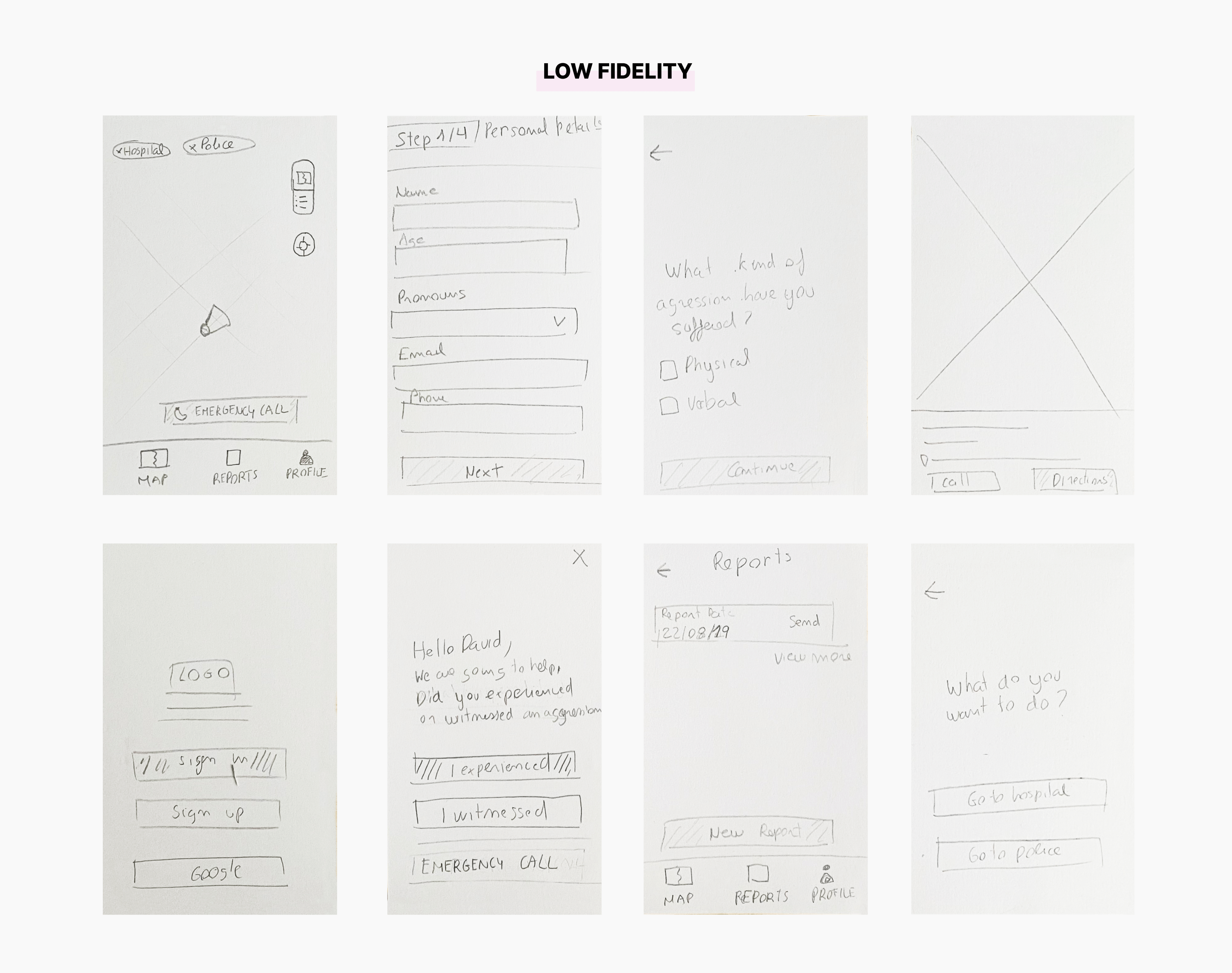
I tested at least 15 users to review the buttons. In the end, the copy had so many iterations. We checked together with the psychologist of the OCH (Observatori Contra l’Homofobia) to validate it.
The app should be designed with simplicity and accessibility in mind. Its purpose is to provide users with a safe space that allows them to feel supported and empowered. The process to report an attack can be very demanding on the user and since it requires time and effort, the experience should encourage reporting without forcing it on somebody.
The insights from the user interviews together with the sessions with the OCH, the user persona and the user flow map – helped me define the main directions of how the first touch in the platform should be:
1. The onboarding experience should be simple, quick, and autonomous.
2. They should have quick access to an emergency call.
3. The app should not be invasive to the users. If they get notifications must be the strictly necessary ones.
4. The user should be encouraged to submit the report with the OCH but not forced.
5. It should feel as if they have been guided and accompanied throughout the process.

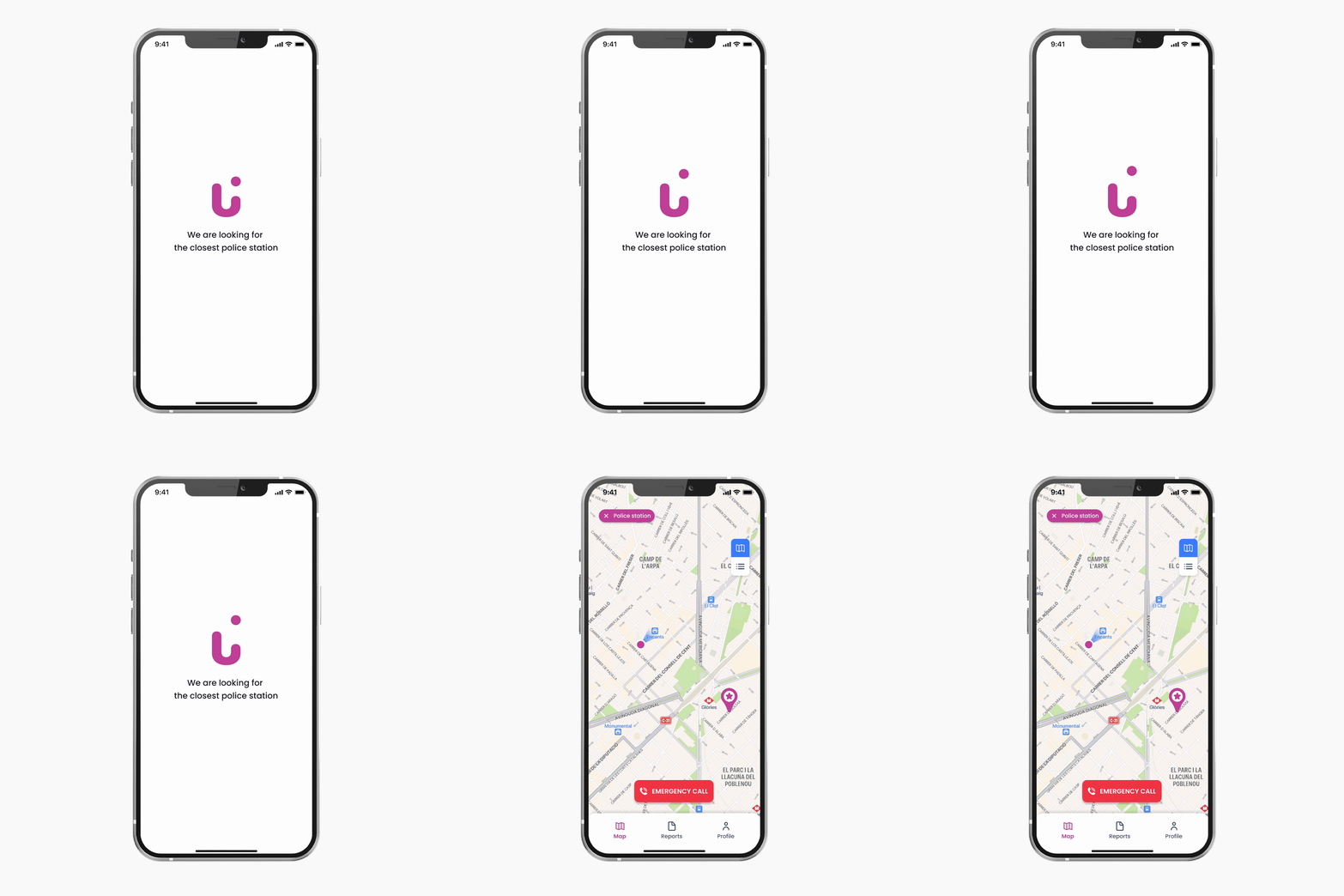
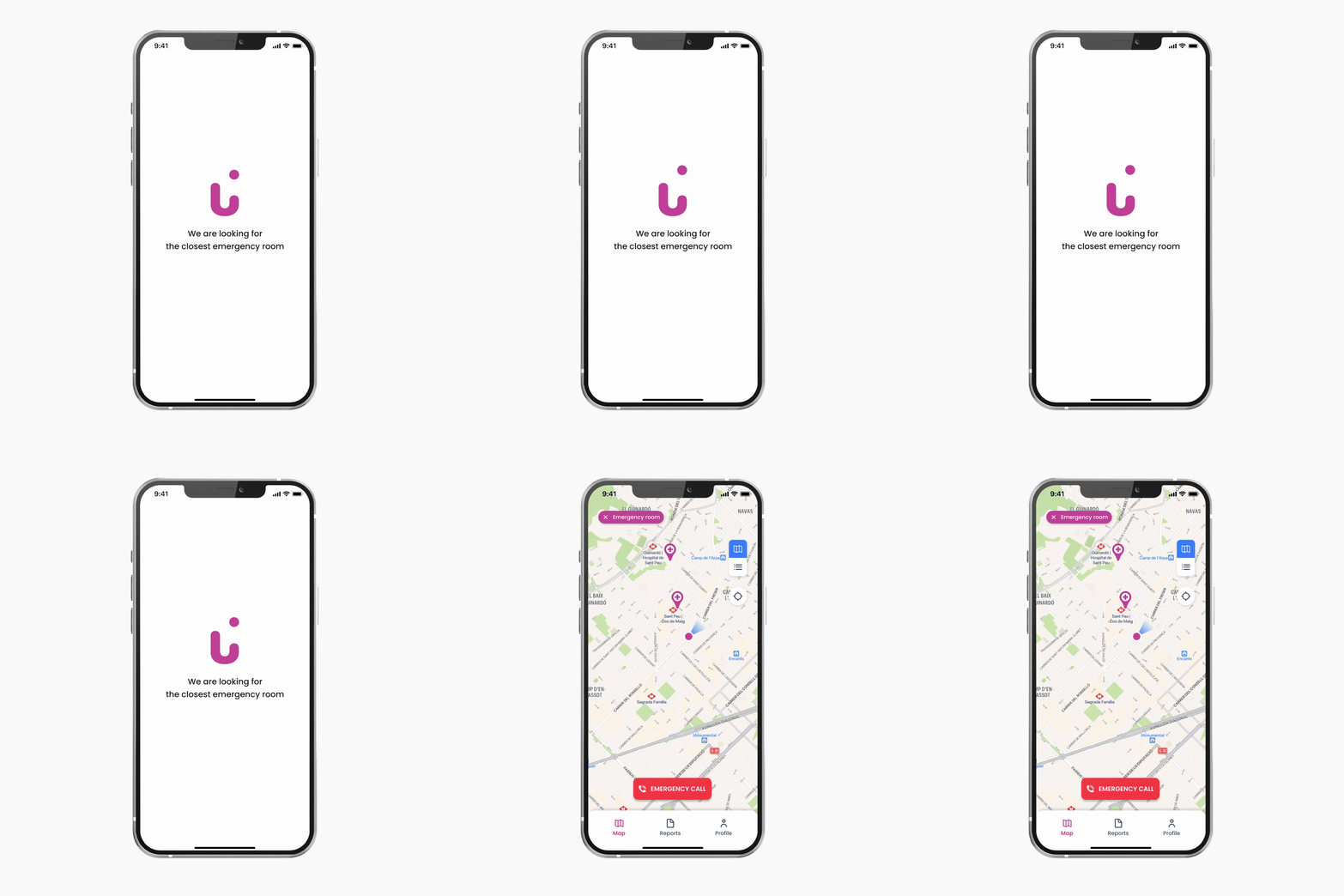
One of the primary goals is to help the user find the nearest emergency room or police station. Without forgetting that at all times users should be able to call these services because we need to consider that they may not be in a condition to think and answer questions.

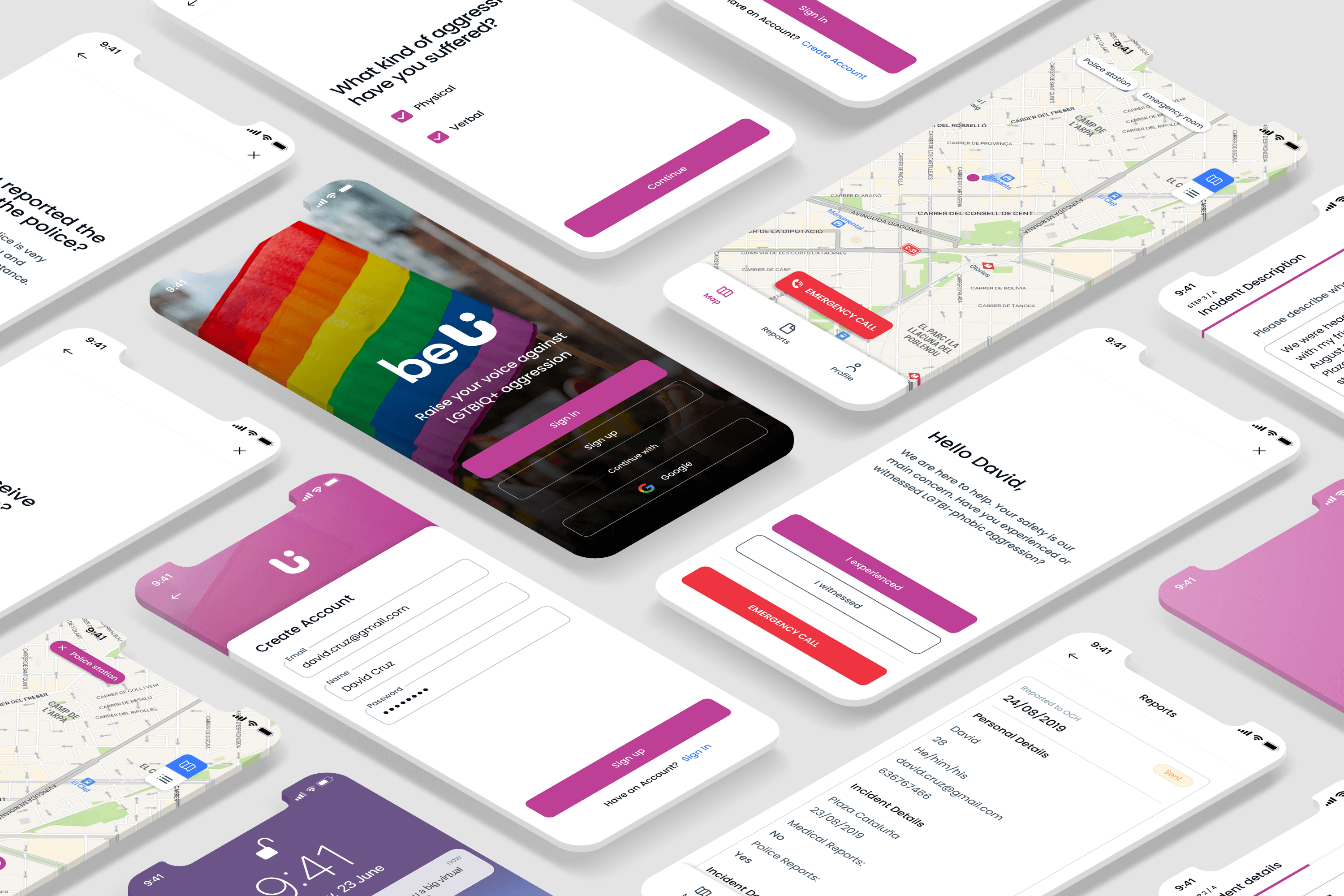
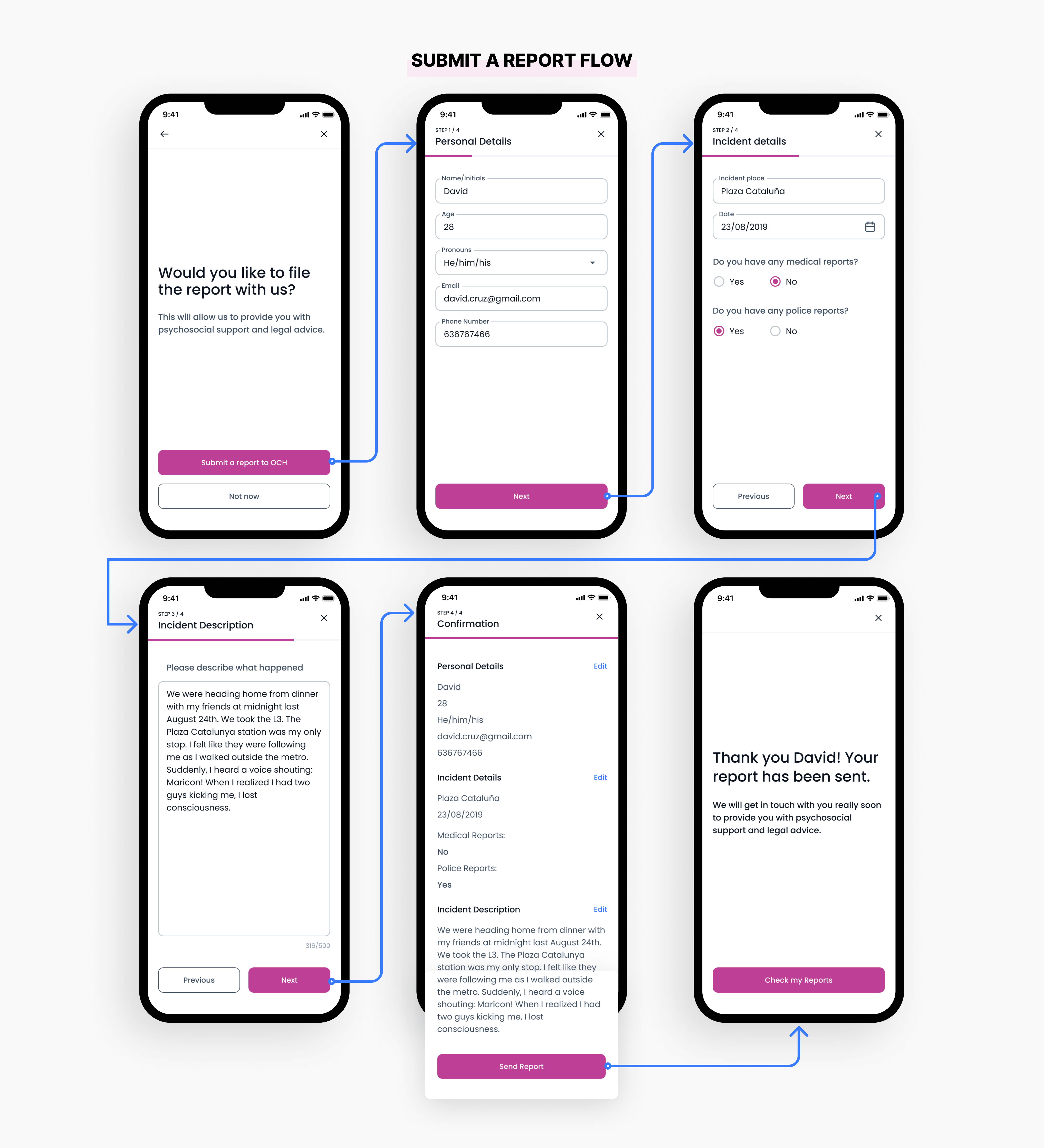
The app was designed to provide a four-step process for people who want to report an act of discrimination against LGTBIQ+ people. Through its process, users can submit a report and receive legal advice and physcosocial support from the OCH.
This project was a small scale, one-off experiment to see if something of this nature could be completed in the time allocated. The outcome of the project was a proof of concept. There was no impact however, I enjoyed working on it as my idea for the final master's project was to create something meaningful that can have an impact in a near future on our society. Although I want to pick up again as soon as possible the project and try to start the conversations again with OCH to make it real and measure the impact of it.
Considering possible future scenarios of the app developed, I thought of creating partnerships with FRENOW, Cabify, or other transportation alternatives to help the users get to the closest emergency room or the police station.
Be U helped me understand the physical and mental impact of an assault. It was hard to hear about the experiences. I was so touched and will be eternally grateful to the people that dared to talk with me about it.
There is a lot of work that needs to be done by the governmental institutions to build back trust and repair the damage done to the community so people can feel safe and trust the police again. This work needs to be done first with the transgender community, which is the most affected by this situation.
Design-related, this project helped prioritize the functionality, always having in mind the main goal: to assist people who have been assaulted and help them in that difficult moment they are going through, also working closely with the OCH helped me create a journey that make the user feel safe and encourage them to report to the police all kinds of aggressions and get medical attention if needed.
I want to end this project by saying that every small thing that we do, say or create will help the main goal which is to live in a world where all the members of LGTBIQ+ community are seen, respected, understood, and loved.

